Thursday, October 21, 2010

A very spooky dive......a Halloween treat.


Yesterday, I dove the Larchmont. Located 3 miles Southeast of Watch Hill, this is the wreck of a paddle wheel steamer sunk in 1907.  The story of its sinking is very sad. On an extremely cold and stormy night in February, the Joy Line Steamer "Larchmont" left port in Providence en route to New York. The winds were strong and the seas very rough when the Schooner Harry Knowlton ran into its side.  The two ships collided with such force, they were momentarily stuck together until the rough seas tore them apart again. The gash in the Larchmont was so large that icy water began rushing into the lower decks immediately.  There were 150 passengers and 50 crew members taken by surprise when the ship started to sink.  Only 19 people were able to survive the freezing conditions. All of the survivors were treated with frostbite and pneumonia.
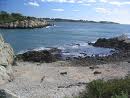
      The dive itself is also a bit spooky. One hundred and three years later, there are just skeletal remains of the paddle wheeler.  (No, thankfully nothing of the victims..) It is one of the darkest New England dives I've done. We started out with Atlantis Dive Charters on an absolutely perfect morning. After my dive buddy Pete and I did our giant strides, we started to follow the anchor line down.  Normally the light from the surface still lets you see down to the wreck site. On this dive, the surface light cuts out after about 70 feet, leaving you dependant on your dive light. Bob, our Divemaster set the descent line perfectly on the remnants of a paddle wheel. Pete and I set down briefly in the sand at 122 feet to get our bearings.  Gary, the captain of Atlantis had told us about the pieces of wood with brass nails that could be found. The site is so dark however, I wanted to keep the ascent line close at all times!! We swam around for a while, looking at the fantastic variety of marine life. The picture above, is the real view of where we ended the dive. After a long slow ascent, we surfaced and agreed that this had been an awesome dive.
Next week....the Grecian with www.atlantis.nu

Thursday, October 7, 2010

Great expectations...

Once you achieve the status of "certified diver", there are a few things you need to do. In order to improve your skills and make diving easier, find a buddy with more experience or take an advanced diving course.  The only way to improve is to keep practicing.  Diving with someone with more experience will help you to avoid the common mistakes you could make as a new diver. Enrolling in an advanced diving course will allow you more training time with navigation, use of the dive flag, boat diving, night diving and other new experiences under the guidance of a PADI Instructor.
As a certified diver, you are now responsible for keeping up with your skills and physical conditioning.  We all know that diving can be strenuous on some occasions, so a good fitness regime is important. Keeping your dive skills refreshed means that if a problem does occur, you will be less likely to panic or make bad decisions.
After any dive, think about the different stages and if you could make any improvements. How could you make the entry and exit easier? How could you use less air and minimize the movements of your hands and fins? Are you a good dive buddy? How much weight do you really need? Just a few things to think about...

Tuesday, September 28, 2010

It's not over.......

Some of the best New England diving occurs after the summer is over. The visibility increases because there is less particulate, like fish eggs and algae in the water.  The thick eel grass dies down, but the water is still warm enough for a lot of sea creatures to be moving around.  Night dives bring out an abundance of lobsters, sea robins, squid and the possibility of tropical fish.
The water temperature in the fall is often warmer than the air temperature. Also, donning a thicker wetsuit is less strenuous in the cooler weather. Although you will not perspire as much getting into the water, bring an extra sweater for after the dive. There is nothing better than enjoying the outdoors on a fall day! We can expect the water to be warmer than 50 degrees into late December.
The fall is also a great time to start practicing with a drysuit. As drysuit prices continue to fall,  it might be time to think about extending your season.  We dive all winter and sometimes use our drysuits on deeper summer dives. (ie. U-853) Wearing a drysuit requires a bit more training, usually starting with a pool experience before getting into the ocean.  If you are interested in discussing the benefits of drysuit diving, give us a call or e-mail. We would be happy to set up an introductory session for you.

Wednesday, July 14, 2010

You say fluke, I say flounder.......you say summer, I say winter...

One of the biggest mysteries of the sea (or maybe just to me) is how to tell the difference between winter flounder, summer flounder and fluke.  To solve one question, summer flounder and fluke are the same fish. Summer flounder are found in coastal waters from the southern Gulf of Maine to Florida.  The Summer flounder, like other species of flatfish have both eyes on one side of its head.  Fluke (aka summer flounder) are considered left-handed because both eyes are on the left side of the fish. To clarify, look at the fish as a whole with the dorsal fin ("back-bone"on top.  To figure out which side is left or right, imagine the flounder turned on edge like a regular fish with its eyes above the mouth. If the fish has eyes on the left side of the body it is a summer flounder. If the eyes are on the right side, it is a winter flounder.The fish pictured above is a winter flounder we took a picture of at Ft. Wetherill, RI.


Saturday, May 22, 2010

A weekend of diving....


This Sunday we will be completing an Advanced Openwater diving course.  The last two dives will take place at Ft. Wetherill State Park in Jamestown, RI.  The PADI Advanced Course consists of five specialty dives and is designed to fine tune your abilities after completing your Open Water course.  Last Sunday in the pool, the students completed the Peak Performance Buoyancy workshop. We worked on proper weighting, specialized finning techniques and hovering.  We also spent time learning how to use lift bags and pony bottles.  These two pieces of equipment are frequently used on deep and wreck diving adventures.  Thursday, we completed the navigation and night diving specialty requirements.  On the night dive we saw lobsters and northern sculpin.  The objective of the navigation dive was to be able to do some underwater exploration without getting lost in low visabilty conditions.
This Sunday, we anticipate beautiful weather. It may even be........hot!!! This means that the ocean water is getting warmer and more suitable for long comfortable dives.  The deep dive is located on a wall and allows us to gradually reach a depth of 80 feet.  The wall is covered with gorgeous anemones and it is common to see skates, sea robins, and tube worms.  This is also a great dive for the underwater naturalist and photographer specialty courses. For more information on the Advanced Openwater Course, go to our website. http://www.seaviewscubact.com/

Saturday, May 8, 2010

Sexy Saturday - Is there something in the water?

"What is all that stuff in the water?" This is a common question after completing a spring time dive.  The good news is, during the summer months you will see a lot more fish and lobsters.  The bad news is, right now you are swimming through their eggs and larvae!
Ichthyoplankton is the scientific term for the eggs and larvae of fish that are found near the surface of the oceans.  Most fish larvae drift along with the surface currents until they are developed enough to swim on their own. New England lobster larvae spend the whole summer as free-swimming plankton near the warmer surface layer. Horseshoe crabs produce thousands of eggs and there are many species of jellyfish floating through the water column at all depths.
So what are we swimming with? The list is amazing. Recent studies of Long Island Sound*, have found the larvae from different species of flounder, hake, mackeral, scup, butterfish, horseshoe crabs, lobsters and more. We also see hydromedusa, siphonophores, comb jellies and moon jellies. (all non-stinging)
So next time you go out to Stonington for a dive.......

*http://www.nae.usace.army.mil/projects/ct/mtapa/moheganefha.pdf

Saturday, May 1, 2010

When animals (fish) attack!!!!

On our recent trip to Cozumel, I was bitten by a Damselfish!  No blood was drawn, but I am sure that if I had not been wearing a full 3mm wetsuit, I might be missing a tiny area of skin!  Notoriously territorial, the many species of Damselfish are not afraid to attack divers and chase away intruders. This is very impressive for a fish that is usually only 3 to 6 inches long. Their tiny mouths are lined with sharp teeth.
Damselfish are very aggressive and quickly attack anything within their proximity. After laying approximately 200,00 eggs the female swims away and the male takes over to guard the eggs, attacking everything in sight until they mature and hatch.
I feel special though.  The chance of being bitten by a fish underwater is slim.  Most fish rely on clever color changes to blend into the environment and avoid being seen by predators. Other species rely on speed and maneuverability to make a quick escape.  Pipefish and Seahorses are protected by thick scales and bony plates that make them hard to ingest.  The Porcupine fish inflates a spine covered body and Scorpion fish, stingrays and Stonefish have venomous spines to discourage predators.
Most fish are carnivores (meat eaters) that eat shellfish, worms and other fish. Oh, and the occasional diver!