Friday, March 11, 2011

Be prepared......to scuba dive!!!

There is an exciting new opportunity for the Boy Scouts of America......................the Scuba Diving Merit Badge!!

Working in co-operation with PADI*,  the Scuba Diving Merit Badge is a challenging and exciting addition to the already numerous opportunities of scouting.


 Seaview Scuba is proud to work with our local troops.  We offer a Youth Program discount and we can design a schedule around some of the busiest schedules. Our PADI Open Water Diver Course consists of 4 classroom sessions, 2 pool sessions and 4 open water dives. As part of the exciting pool sessions, the scouts will learn the basic skills of diving, like regulator recovery and mask clearing. In the ocean, students will learn the fundamentals of navigation, the "buddy system", and fish identification.


After completing the Open Water Diver Course, the requirements for completion of the Scuba Diving Merit Badge include completion of the Swimming Merit Badge and First Aid Merit Badge.

A PADI Open Water certification is a great start to a lifetime of adventures under the surface of the oceans, lakes and quarries.  Once certified, the opportunities for advancement are endless.  Some colleges and universities even offer credit programs for PADI certifications. Certified Rescue Divers have opportunities with local dive rescue teams or can opt to continue on to professional levels.

For more information, please call Mike or Sharon at 860-442-7279


*Professional Association of Dive Instructors   www.padi.com

Saturday, January 8, 2011

Choosing the right gear.......

How do I go diving today and stay comfortable? 
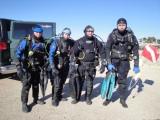
If I go out today, it will be in a trilaminate drysuit with my Fourth Element Arctic undergarment. I will also be wearing a 7mm hood and three finger mitts.  The key to a successful dive in January, February or March is planning.  When I arrive at the dive site, my gear is already set up.  This means that my BC and regulator are on the cylinder, my mask is defogged, my fin straps are loosened and my weight system is ready for donning.  The less time I have to spend with last minute preparations, the better able I am to stay warm....especially my hands.
I dress like I am going to the arctic circle with layers of thermal protection, a hat and good thick gloves.  I am able to change into my drysuit in the van, but if I didn't have that option I would be just stepping out for a moment to get into my drysuit.  Keep your head covered until you are ready to put on the drysuit hood. Always protecting your hands will allow for more dive time after you are submerged.
Hands....My biggest weakness for diving in the winter.  I use three finger mitts with velcro straps. The velcro straps can be cinched to keep the flow of water to a minimum.  I glued the straps on to the gloves myself.  I have also used hand heaters inside the gloves to give me a little more warmth and extend my dive time. The only reason I will cut a dive short now is because my hands are too cold.
How cold is too cold?  When you start to shiver or have pain in your hands, it's time to get out of the water and get warm.  After the dive, I take care of myself first by leaving my gear set up and focusing on getting warm and comfortable again.  If I allow myself to get too cold or uncomfortable, I know that I won't want to dive anymore. "Work smarter not harder!"
Once again dressed for the Arctic, I put away my gear and joke with my dive buddies about what "hard core divers" we are. I am warm, dry and pleased with my diving adventure.  Springtime is four months away, and there is no way I can stay out of the water that long!

Saturday, December 18, 2010

The festive Christmas Tree Worm....

photo by Michael Mulford
 Christmas tree worms are tube dwelling annelids (worms) found in tropical ocean waters all over the world.  They have beautiful twin spirals of plumes or gills that are used for feeding and respiration.  The Christmas tree worm is the most easily recognized polychaete (Greek- with much hair) worm because of their shape and range of vibrant colors.  They can be found in orange, yellow, blue and white.
The worms have two spirals, both shaped like Christmas trees. The spirals consist of radioles or feather-like tentacles used for feeding on particles of food or plankton.  These tentacles of cilia (fine hairs) are also used for respiration and are sometimes referred to as gills.
Christmas tree worms feed by catching particles of food and plankton as it goes by in the water.  The food is passed down a groove or ciliary tract by little hair like extensions.   These hairs generate water currents to move along food and mucus to the mouth. As food particles are sorted, larger particles are discarded and sand is stored to be used for tube building.
The Christmas tree worm is anchored into a burrow that bores into live coral. When male and female worms reproduce, they cast eggs and sperms into the water.  The eggs are fertilized and the growing larvae settle on to a coral head.  The worm then builds a tube on the surface of the coral. As the coral grows, it buries the tube in the skeleton of the coral.  The worm is then protected by the coral with only its head showing.
The worms are very sensitive to disturbances. The slightest touch or shadow causes the worm to quickly retract the feather like tentacles.  As a scuba diver approaches with a camera, the worm may quickly disappear.  If the underwater photographer waits about a minute though, the feather like spirals re-emerge slowly and majestically.

The PADI Underwater Digital Photography specialty offers a lot of helpful information on how to capture photos like this for yourself.
Come in to Seaview Scuba and talk to our specialty instructor about opportunities for training.  You may even decide to go on a Seaview Scuba dive trip to guide you to the best photo opportunities.

Thursday, December 2, 2010

A few of Mike's favorite things......

No.....not whiskers on kittens!  Although Mike "loves" to hear about my cats......not!

1. Ikelite PC lights.........    durable and reasonably priced. Three sizes to choose from.


2.  PADI Digital Underwater Photography Specialty.
Start the course on-line and finish with two ocean dives with your PADI Master Scuba Diving Instructor.......Mike.


3.  Spring straps......replace your current fin straps with the easily donned spring straps. A great stocking stuffer!!
                                       

Wednesday, December 1, 2010

A few of my favorite things........

Although Mike and I are not as rich as Oprah, we decided to put together a list of our favorite things. Don't get excited, there will be no car give aways or paid vacations to Australia.  Our list will probably not make you cry, jump up and down or wet yourself but.........


1. Fourth Element..........anything they make! Hoods, gloves, wetsuits and drysuit undergarments.  If you saw Mike and I this season, you may have noticed that we were dressed head to boot in Fourth Element.  The quality of their neoprene is excellent. If you see us this winter, we are wearing the Fourth Element undergarments under our drysuits.  I actually wear mine outside for shoveling snow too....so warm!! 


2. Scubapro MK17/ G250V...........the workhorse!  One of the best products ever made is the G250 second stage from Scubapro.  This balanced adjustable second stage delivers air with little inhalation effort and great air flow.  Combining this with the environmentally sealed MK17 first stage means that this regulator is ready for any and all diving conditions.  Mike and I both dive this regulator system. We may even have two or three of them!!


3.  Aladin TEC 2 computer......multi-gas computer. Easy to operate and download.  Mike has the Aladin Galileo Sol air integrated computer, and it is wonderful. It even has a digital compass program !!  I have been diving the TEC 2G for years now.  No additional software is needed to download profiles of your dives....so no addition $$ on cradles.  The price is very reasonable and the computer is very easy to use and understand.  A computer like this is perfect to bring on a dive trip if you don't want to bring your BC and regulator.


More favorites to come........


Wednesday, November 17, 2010

"Get the lead out!"


Brass diving boots circa 1920'S

The most common problem for new divers is understanding how much weight they actually need.  Several factors are involved in determining how much lead will have to be worn into the water. 
Are you diving in salt water or fresh water?
   -You will be more buoyant in salt water than fresh because salt water is denser. The addition of salt to fresh water increases the density by 2.5%. This means that salt water weighs 2.5% more than an equivalent volume of fresh water.

 What type of wetsuit are you wearing?
-Neoprene is a synthetic material that was invented by Dupont in 1930.  In diving applications, neoprene provides insulation from the cold because the material is "foamed" with nitrogen gas. The gas pockets cause the material to become very buoyant, so a diver must compensate by wearing weights. The thicker the neoprene, the more weight that is needed to offset its positive buoyancy. A diver wearing a 7mm wetsuit with boots, hood and gloves will need a lot more weight than a diver in a 2mm shorty wetsuit.

A more current style of weight belt!

What are my choices?
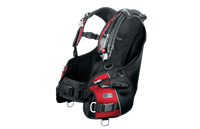
There are several new options for weight systems available. Of course, the most important feature of a system is that it can be released with ease in an emergency.  The standard weight belt with a right hand release is still common. Many manufacturers make weight integrated BC's with quick release pockets to make divers more comfortable.

Integrated weight system


Need help?
Most divers rely on information obtained in certification courses.  A detailed logbook will remind you how much weight was needed in both the pool and ocean training.
The PADI Peak Performance Buoyancy course is a great continuing education course. This course teaches you how to determine the exact amount of weight needed to be "not too heavy and not to light."
Proper weighting allows you to move smoothly through the water, hover vertically or horizontally and conserve air.
For information on Advanced Openwater and Peak Performance courses, contact us at: seaviewscuba@sbcglobal.net

Tuesday, November 9, 2010

We are going hunting....scallops.

Scallops are mollusks, like clams and oysters. They belong to a group called bivalves, meaning the shell consists of two asymmetrical halves joined by a flexible ligament called a hinge. Scallops are found in both bay waters and the sea.  The habitat of a sea scallop is a bottom composition of rough cobble, shells, or coarse sand. They do not attach to anything but instead move through the water by opening and closing the shell for propulsion. The muscle that controls the hinge of the shell is large and meaty, and also the goal of our hunting trip. 
This year, the scallop excursion begins on a cold morning in Gloucester, Massachusetts. We board the boat with the blustery wind in our faces and prepare for the 1 hour boat ride to scallop territory.  The boat captain, Steve always lets us know that we may not find any. Scallop population varies from year to year. A scallop may live as long as twenty years and during that lifetime produce as many as 270 million eggs. Some years though, populations are more scarce.
Our dive begins with a giant stride into water that is 51 degrees. The depth of the dives is about 50 feet and this year visibility was only about 10 feet. In the past we have had great visibility but colder water. I think I prefer warmer water. As you swim along the bottom, the scallops are on the sand making it easy to pick them up and put in your game bag.  A thirty minute dive will usually yield about 50 to 75 scallops depending on the site. Once the dive is over, the bag is tied off to the flag and the diver uses the flag line to ascend.  On the surface, Captain Steve brings the boat over with great skill to pick up each diver.  The boat comes straight for you then turns at the last minute to put the boat ladder within reach.  Captain Steve has had many years of practice and it shows. Once all the divers are aboard, the boat circles around to gather up all the scallop bags.  Some divers prefer to schuck the scallops while on the boat, while others wait until later.
The end result though, is something pictured here. A lightly sauteed scallop with asparagus and a glass of wine. The perfect ending to a great day of diving.